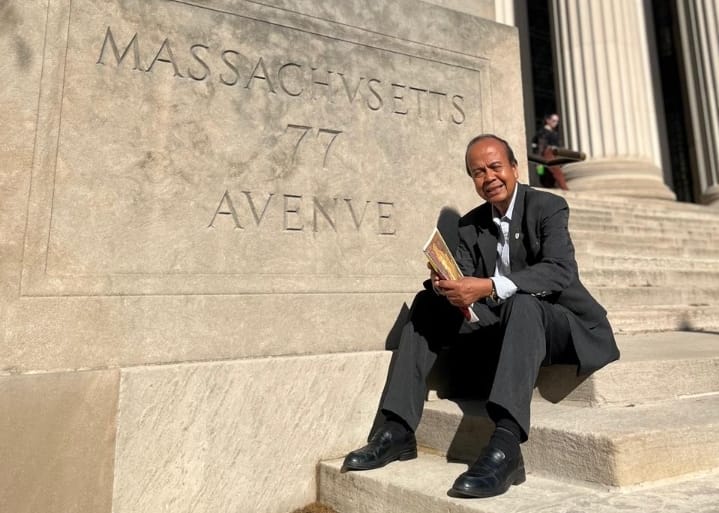
Artikel berikut ditulis oleh Hafid Abbas, dipublikasikan di Rilpolitik.com. Tulisan ini dimuat ulang secara utuh sebagai bentuk apresiasi terhadap karya penulis.
By: Hafid Abbas
Visiting Professor, Asia Center, Harvard University (2006)
In a world increasingly shaped by identity politics, widening inequality, and social
fragmentation, the moral foundations of civilization are often overshadowed by struggles for power. Yet the endurance of any society depends less on authority than on humanity. A society does not survive and remain stable primarily because of power, control, laws, or political authority. Instead, its long-term strength and continuity depend more on human values—such as compassion, justice, solidarity, empathy, and mutual care. At its most essential level, religion calls not merely for belief, but for love enacted—love translated into concrete service. Within this framework, the humanitarian engagement of Habib Abubakar bin Hasan Alatas Azzabidi, Grand Mufti of the Sultanate of Moloku Kie Raha in North Maluku, Indonesia, offers a compelling model of faith expressed through action, comparable in spirit to the life and work of Mother Teresa in Kolkata
First, Habib’s understanding of dakwah (Islamic outreach) extends beyond preaching (bil lisan) or writing (bil qalam) toward what Islamic tradition calls bil hal—preaching through action. For him, religious authority is meaningful only when it addresses the most immediate wounds of society. His leadership therefore moves beyond the pulpit into the lived realities of marginalized communities, where poverty, illness, and exclusion are daily experiences rather than abstract categories. Religion, in this praxis-oriented vision, must not remain rhetorical; it must become restorative. Faith is measured not solely by theological articulation, but by its capacity to heal social fractures and reaffirm human dignity. In this sense, Habib’s model of religious engagement challenges the dichotomy between spirituality and development, demonstrating that ethical conviction can serve as a catalyst for institutional and social transformation.
Second, this vision is concretely expressed in his engagement with individuals affected by leprosy in North Maluku. Leprosy is not merely a biomedical condition; it carries a heavy social stigma that often inflicts deeper suffering than the disease itself. Those affected are frequently marginalized, viewed with suspicion, and sometimes excluded even from their own families. Through substantial zakat distribution and sustained social assistance, Habib’s interventions have gone beyond material relief. They aim to restore dignity—recognizing patients as full human beings rather than objects of pity. In this respect, religious outreach becomes a form of moral reconstruction, countering exclusion by reestablishing worth.
At the same time, Habib has institutionalized large-scale food distribution for economically vulnerable families. Tens of tons of rice are distributed monthly, and communal meals—especially during Ramadan—feed thousands each day. These initiatives are not episodic charity but structured commitments embedded in community life. Food security here functions not only as welfare provision but as preventive peacebuilding. Extreme deprivation often intensifies social tension, deepens resentment, and widens inequality. By ensuring reliable access to basic sustenance, such programs help stabilize communities and mitigate latent conflict. Rice, in this context, becomes more than nourishment; it becomes an instrument of solidarity and a symbol of shared responsibility.
Third, beyond immediate relief, Habib’s investment in education reflects a long-term strategy aimed at breaking structural poverty. Scholarships for children from marginalized families seek to interrupt intergenerational cycles of deprivation. The American anthropologist Oscar Lewis described persistent deprivation as a “culture of poverty,” a condition that reproduces itself when access to opportunity remains limited. Without educational intervention, poverty risks becoming self-perpetuating, narrowing life chances for successive generations. By expanding access to schooling and learning resources, Habib’s initiatives move from charity toward empowerment. Education becomes an instrument of social mobility, enabling children to envision futures not predetermined by inherited disadvantage. In this shift from relief to transformation, religious commitment aligns closely with sustainable development goals.
His humanitarian engagement also extends to emergency response and public health. Through coordinated networks of students and associates across Indonesia and abroad, assistance is mobilized during floods, landslides, fires, and volcanic eruptions. Medical aid for low-income communities and blood donation campaigns further demonstrate an ethic unconstrained by geography or group identity. Suffering, in this view, constitutes a universal call to action. Solidarity transcends locality, ethnicity, and sectarian affiliation, affirming a shared human responsibility.
Fourth, in global perspective, this model of engaged compassion invites comparison with Mother Teresa and the Missionaries of Charity in Kolkata. Her lifelong service to the dying, the hungry, and the abandoned crossed religious and national boundaries, embodying humanitarianism as vocation rather than performance. Like Habib, she demonstrated that authentic service emerges from moral conviction rather than public recognition. Neither spectacle nor political ambition defined her work; rather, quiet consistency and unwavering dedication shaped her legacy.
The philosophical foundation of such engagement resonates with broader ethical traditions. Mahatma Gandhi affirmed that where there is love, there is life, understanding love not as sentimentality but as disciplined nonviolence and constructive moral force. Similarly, Plato suggested that acts of goodness ennoble the soul of the giver. Humanitarian action thus entails reciprocal transformation: recipients regain hope and dignity, while givers discover meaning and moral refinement. Love, when translated into institutional practice, becomes a form of social energy capable of bridging divides of ethnicity, sect, and political affiliation.
A humanity-centered model of dakwah therefore carries significant implications for global peacebuilding. Peace cannot be sustained solely through diplomatic agreements or political settlements. It must be cultivated in kitchens that feed the hungry, classrooms that widen opportunity, clinics that heal the sick, and communities that welcome the marginalized. Addressing hunger and underdevelopment is not merely an economic undertaking but a moral imperative. Material deprivation weakens the body; deprivation of compassion corrodes the spirit and fragments society.
Ultimately, the shared message embodied by Habib Abubakar bin Hasan Alatas Azzabidi andMother Teresais that hunger and underdevelopment require more than policy instruments—they require ethical commitment. Love expressed through feeding, educating, healing, and restoring dignity constitutes a foundational human necessity. As the Persian sage Jalaluddin Rumi wrote, “The spirit of the universe is love.” When love moves from abstraction into sustained action, it becomes a transformative force—quiet yet powerful enough to shape history, strengthen social cohesion, and nurture enduring peace.
Sumber asli: Rilpolitik.com – “Habib and Teresa: Confronting Hunger and Underdevelopment through Love” (27 Februari 2026)
https://rilpolitik.com/habib-and-teresa-confronting-hunger-and-underdevelopment-through-love/